Did you know that more than 70% of the world's grape production is converted into wine? Grapes and wine date back more than 7000 years, as vessels dating back to the Neolithic age, containing remnants of wine, have been found in Iran. Wine has been used for ceremonial and celebratory occasions ever since, and a moderate intake of red wine, in particular, is known to have many health benefits.
These grapes are chardonnay grapes from a vineyard near Napier in New Zealand. Australia and New Zealand are in the forefront of the so-called New World winemaking, using modern technology to wring every drop of goodness from the grapes. When I took this picture, I had to be very careful with the strong afternoon sunlight, and spent a considerable amount of time finding an area that wasn't too harshly lit.
Photographers have had a love affair with wine and its various accompaniments since the very early days, and I confess to a love of wine almost as great as my love of photography.
EXIF: Nikon D70; Nikkor 18-70 mm DX; ISO 200; 1/50 sec; f5.6.
TFF

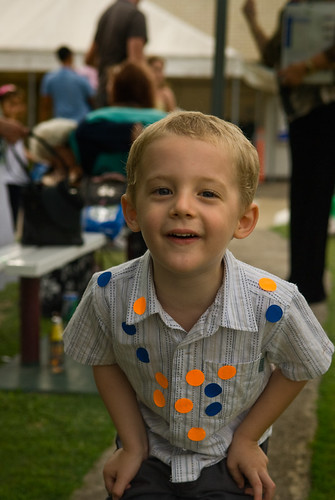
On the Easter long weekend, I went to a friend's engagement party. They did a really fun thing and arranged for the guests to play lawn bowls after a very tasty lunch. To manage the large number of people, there was a system of stick-on dots in use, and this little boy wanted to collect as many dots as possible. He stuck them all over the front of his shirt in a serious fashion statement.
The fun started when he asked for his picture to be taken. A lady in his group took the photo, and the boy wanted to see it. Problem? She was using a film camera! Try as she might, she could not explain to this little boy who has obviously only ever seen digital cameras, that she was unable to show him his photo. He thought she was refusing to show him the image - he didn't realise that she couldn't show him.
Anyway, I was able to help out by offering to take his picture on my digital camera. Once he had seen how cool he looked in spots, he was as happy as Larry. Ain't technology wonderful?
EXIF: Nikon D200; Nikkor 17-55mm DX; ISO 200; 1/640 sec; F4.
TFF
 When I was a kid here in Brisbane, I used to visit the "Ekka" - our nickname for the Royal National Association Exhibition. The Ekka was an annual festival that showed rural Australia to city folk. In its early years, it was all about farm produce, livestock and ring events like showjumping and woodchopping, but over time creeping commercialism provided show bags, Tasmanian potato chips and Sideshow Alley.
Sideshow Alley is an amalgam of gaudy rides, gross fast food (giant fairy floss and Dagwood Dogs to name a couple) and tent shows featuring the likes of the Bearded Lady and Jimmy Sharman's boxing troupe. One tent show that bobbed up every year was the Cultured Pearl Exhibition, where for a few bob, you could see actual Japanese women setting cultured pearls into jewellery.
Years later, I visited an area in Japan where they demonstrated the old methods of diving for pearls and the modern methods of making jewellery. Traditionally, it was females who did the diving, wearing a very practical and modest full-length white suit and goggles. The used a floating wooden tub which they towed around behind them to hold the recovered mussels they brought up from below the surface, only to then dive back underwater to search for more (above, top).
The mussels were then brought ashore to be shucked and cleaned, and examined for pearls, which were sorted and graded for quality (above right). This woman was even wearing the same uniform as I used to see at the Ekka as a kid.
TFF
 No visit to China would be complete without a glimpse of the Great Wall, and we were able to visit a section of the Wall just north of Beijing. Here the Wall is in quite good repair, and the difficult terrain gives some idea of the immense task that would have been involved in its construction. Wikipedia says that the Wall's construction may have commenced about the 5th century BC, and that it stretches for more than 6400 kilometres.
At its peak, it was guarded by more than 1 million soldiers, and during its construction around 2 million workers died. Wikipedia also puts to rest the urban myth that the Great Wall is the only man-made construction visible from the moon, saying that it is difficult to see even from a low orbit of the Earth.
 The section that we visited was quite wide, but very steep. On the day we were there, at the end of winter, there was an extremely cold wind that forced the temperature down to around -25 degrees Celsius. All the tourists were rugged up to combat the severe cold, but the hardy locals seemed to be impervious to it. In the towers, the soldiers would have been able to build fires to warm themselves. I can only imagine the hardship that must have been endured by those workers who built the Wall.
EXIF: not available
TFF
 As discussed in yesterday's post, I was fortunate enough to visit China about 25 years ago, and found it to be an amazingly interesting place. I haven't been back since, and I would really like to go there again, because I think the most incredible changes would have occurred in the meantime.
When I was in Beijing, for example, cars were relatively few in numbers, while bicycles were in plentiful supply. Hordes of bicycles would clog the streets in the mornings and afternoons, riders well protected against the freezing winter weather.
I don't know what the rules are now, but back then, all tourists had to be escorted by someone from the Tourist Bureau. The person we had was really excellent, but you had the feeling that you were only to go to certain places. In Beijing, one of the most fascinating areas was Tiananmen Square, where there are many monuments and statues to the People's Revolution and Chairman Mao. I was able to photograph this marvellous statue at the right time of the day for the sun to provide shadow detail, emphasising the depth of the figures. Note the detail in the hands, faces and weapons. (A larger image can be seen here.)
EXIF: sorry!
TFF
 Today's image is from China, where this young boy was feeding the pigeons at a temple. Feeding birds of all varieties is popular with the Chinese, whereas in Australia we regard some species as pests. Most of us wouldn't feed pigeons or sparrows because they are rather messy to have around.
I probably took this image more than 25 years ago using film, the scan to digital is probably more than 5 years old, and the most recent post processing occurred today. so we have an amalgam of three generations of technology. I still have the original slide, so I may rescan it to see if I can improve the resolution.
The things I like about this photo are the body language of the boy (half-excited; half-frightened), the indulgent look on the boy's father, and the blur of the pigeons fluttering around the feed in the boy's hand. By getting down low and having the camera at the boy's eye level, I was also able to fill the foreground space with pigeons, giving greater depth to the image.
EXIF: unknown
TFF
 It's getting harder and harder to take candid images. In many places, photographers are treated with suspicion, and in some cases harassed by police and security workers. Unfortunately, this sort of activity has rubbed off on the general public, who are increasingly wary of anyone who points a camera in their direction. Some of the professed reasons for this are understandable, while some are downright ludicrous. I can follow that it is not acceptable to photograph things like atomic power stations and water treatment plants without authorisation. But there was a recent case where a photographer was prevented from shooting in a public mall (not a shopping centre, but an outdoor general use area) because the resultant images would reveal the positioning of the CCTV cameras. The same logic should therefore prevent anyone from taking notes using a pencil and paper!
Anyway, this image is from a local park. The couple in the picture are making a run for a ferry that is just about to depart. They were having fun, as can be seen from the expressions on their faces. Because it was a public place, I am allowed to take their photograph, and because they are not doing anything illegal or even out of the ordinary, I felt entitled to do that. Naturally, if anyone that I photographed asked me not to do so, I would accede to their request - people are entitled to ask for privacy. But generally, when in public spaces, I feel justified in taking photographs of the buildings and the people that happen to be in that space at that time.
I like this picture because it shows people behaving in an ordinary, everyday way, and enjoying doing so. It would be a shame to lose the right to record such activity.
PS - They caught the ferry!
EXIF: Nikon D300; Nikkor 18-200mm VR; ISO 200; 1/100 sec; f5.6
TFF
 The angling arts have never been familiar to me. Once, after a morning's fishing from a friend's boat, I reeled in my line to head home only to find a dead fish on the end of it. I knew blokes who would come to work after a weekend spent fishing and recount their catches. It seemed that most of these fishermen caught far more than were needed for a family feed.
Needless to say then, the world of deep-sea fishing was entirely foreign to me until I visited the town of Russell, in the north island of New Zealand. The local sports fishing club was having a competition, and a boat brought in this catch one afternoon when I was on the jetty. The normal catch and release policy had been suspended for the week of the competition, hence this huge (dead) blue marlin being displayed. Note the blackboard - 282kg. That's some fish.
Because I saw this as being a type of photojournalism shot, I left the onlookers in the shot, and included the successful female angler and the blackboard with all the details.
EXIF: Nikon D70; Nikkor 18-70mm DX; ISO 200; 1/160 sec; f11.
TFF
 It's not every day that you come across a knight in full armour, including a sword, on a horse with livery from the middle ages, so when you do, it is best to make sure that you capture a photograph - otherwise people might tend not to believe you.
This is an actual castle, once protecting a town and dating back over a thousand years. It has over two miles of fortified walls and more than 50 spires. It is believed to have been the inspiration for the castle in Walt Disney's Sleeping Beauty, and some of the scenes for Kevin Costner's Robin Hood movie were filmed here. There are daily jousting tournaments, and other medieval entertainment can also be found readily. Can you guess where it is?
It is the largest fort in Europe, situated at Carcassonne, which is in the Languedoc region of southern France. When I took this picture, I was keen to include the lush green grass and some aspects of the castle as well as the armoured knight and his horse. I normally would prefer not to have the horse facing out of the image, but in this photo the more serious faults are having cropped the horse's hooves and the top of the tower out of the frame.
But the golden rule of photography is "first, get an image", so I console myself that as I have only this one shot of the occasion, it is the best shot I have.
EXIF: film; unknown
TFF
 One of the aspects of photography that really interests me is the ability to show texture in images. Of course, just as it is with most aspects of photography, lighting is the key to being able to illustrate texture. Flat lighting removes texture - you need side lighting to be able to show things like grain and surface texture.
This wooden walkway in Rotorua, New Zealand, interested me when I saw it. It was laid out around a lake, and therefore obviously exposed to the elements. The weathered mixture of swirls and lines looked interesting, and, fortunately for me, the late afternoon sun allowed the camera to be able to see all of that texture.
I composed the shot with the timber running across the long diagonal for aesthetic reasons, and made sure that I had included a couple of the more interesting knots. Post processing consisted of a slight increase in contrast, and then a conversion to black and white.
EXIF: Nikon D200; Nikkor 18-70mm DX; ISO 200; 1/640 sec; f8.
TFF
 You get unintended consequences in photography sometimes. I cannot lie - mostly the unintended consequences are bad news. The type of thing that happens when you haven't reset the ISO after shooting in the dark the previous night, or when the auto white balance setting decides that skin tones are green today.
But sometimes whatever gremlin that has infected your camera (or, more likely, your brain!) actually gives you a free kick and you end up with something better than you imagined.
This is what happened here. I took this picture using film one winter day in Europe. I knew that the trees would be silhouetted against the sky, which, although overcast, was quite a deal brighter than the foreground. What I didn't expect was that the image would end up looking like some sort of charcoal sketch. The swirling clouds and the bare trees had a desolate quality that I hadn't seen before I took the photo. Sometimes the camera just enhances the subject - they say that's what happened when Marilyn Monroe was photographed.
EXIF: not known
TFF

 Our final look at Greece is the island of Corfu, situated off Greece's western coast. Corfu, now recognised as part pf Greece, has a long and colourful history. The forts on the island bear testimony to the struggles between Greece, Italy and Albania over the years. The largest town on the island is also called Kerkyra or Corfu Town, it has been around since the 7th century BC, and it is an extremely pleasant place to visit.
 Corfu Town looks more like an Italian or French town, rather than Greek, resulting from the various influences over the years. It seems to be a shoppers paradise. There are lots of jewellery shops especially, and they seem to have reasonable prices if you are up for a bit of haggling. The old town is quite well preserved, and is made for walking, as the narrow and winding streets are too tight for vehicles.
 Outdoor restaurants abound, and the food we had in Corfu, as in the rest of Greece, was very good and quite cheap. Seafood is plentiful, and the fresh fruit and vegetables are of high quality.EXIF: Canon A620; auto.
TFF